
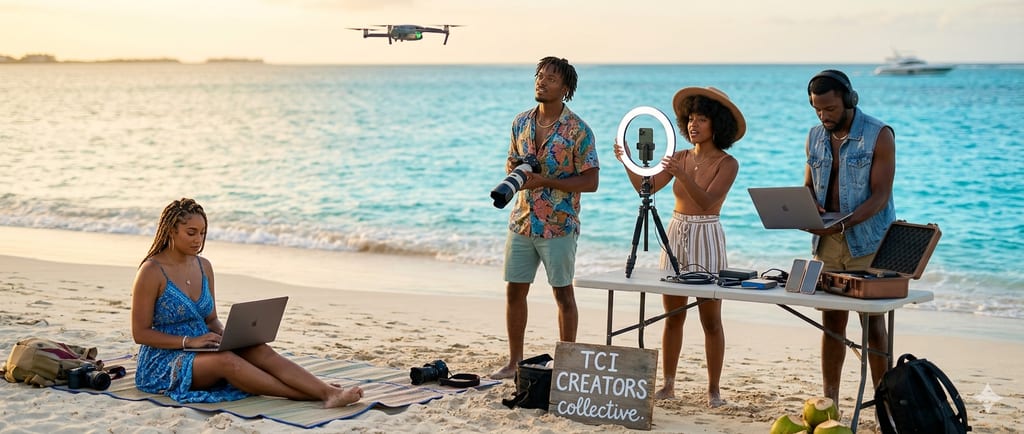
Something is shifting in the way the world consumes content, and the Caribbean is right in the middle of it. Across the region, a new generation of creators is picking up cameras, opening laptops, and building audiences that stretch far beyond their home islands. From Trinidad to Jamaica to Barbados, Caribbean voices are finding platforms, attracting brand deals, and proving that you do not need to be based in Los Angeles or London to build something real in the digital economy.
Turks and Caicos is part of that story. But it is also navigating a set of challenges that make its path in the creator economy uniquely complicated. The islands have breathtaking visual content built into the landscape by default. The culture is rich, the people are compelling, and the stories worth telling are everywhere. And yet, for local creators trying to turn their passion and their platform into a sustainable livelihood, the road is considerably harder than the scenery might suggest.
The Global Creator Economy and Why It Matters Here
The numbers behind the global creator economy are staggering. By most estimates, the industry is now worth well over half a trillion dollars annually and continues to grow. Platforms like YouTube, Instagram, TikTok, and newer entrants are paying out billions to content creators every year through ad revenue sharing, brand partnerships, subscription models, and direct fan support tools. What started as a side hustle for a relatively small number of tech-savvy early adopters has become a legitimate career path for millions of people around the world.
For small island territories like Turks and Caicos, the creator economy represents something genuinely exciting – a form of economic participation that does not require a physical product, a factory, or proximity to a large consumer market. A creator with a smartphone, a good eye, and something authentic to say can theoretically reach the same global audience as someone operating out of New York or Dubai.
Theoretically. The reality, as local creators are discovering, is layered with complications that the platform algorithms do not account for.
The Internet Problem
Before we talk about content strategy, brand deals, or audience growth, we need to talk about infrastructure. Because in Turks and Caicos, the internet situation remains one of the most significant practical barriers facing anyone trying to build a serious digital presence.
Internet connectivity across the islands is inconsistent, expensive relative to local income levels, and in some areas genuinely inadequate for the demands of regular content creation. Uploading high-definition video, managing live streams, engaging with audiences in real time, and maintaining the kind of consistent posting schedule that platform algorithms reward – all of these activities require reliable, fast internet access that is simply not available to everyone in Turks and Caicos at the same level it would be in a major city in North America or Europe.
This is not a minor inconvenience. It is a structural disadvantage. A creator in Toronto can upload a 4K video in minutes. A creator in a less-connected part of Providenciales might spend hours waiting for the same file to upload, burning through expensive data in the process. When the barrier to entry includes infrastructure costs that creators in wealthier, better-connected markets simply do not face, the playing field is tilted before the first piece of content is even published.
The Market Size Reality
Then there is the question of audience. The creator economy rewards scale. Platform monetisation tools – YouTube ad revenue, TikTok’s creator fund, Instagram’s various partner programs – are all designed around large audiences, and the thresholds required to access meaningful income from these platforms are calibrated to markets with tens of millions of potential viewers.
Turks and Caicos has a population of roughly 45,000 people. That is not a criticism of the islands. It is simply a mathematical reality that shapes the creator landscape in profound ways. A creator producing content that speaks primarily to a local audience will hit a ceiling relatively quickly, not because the content is not good, but because the local addressable audience is genuinely small.
This pushes Caribbean creators toward a choice that creators in larger markets rarely have to confront so directly: either broaden the content to appeal to international audiences – which often means de-emphasizing the specific local identity that makes the content distinctive in the first place – or find alternative routes to monetisation that do not depend solely on platform size thresholds.
Neither option is easy. Both require a level of strategic thinking that goes well beyond simply making good content.
The Brand Collaboration Landscape
Brand deals and sponsorships represent the most lucrative income stream for most successful content creators globally. For Caribbean creators, this is an area of enormous potential and genuine frustration in equal measure.
The potential is obvious. Turks and Caicos creators operate in a visual environment that international brands in travel, lifestyle, fashion, food, and wellness would pay significant money to be associated with. A local creator filming content against the backdrop of Grace Bay Beach, or documenting the cultural richness of island life, is sitting on a natural asset that money genuinely cannot buy.
The frustration comes from the reality that most brand partnership infrastructure is still heavily concentrated in major Western markets. The agencies that connect brands with creators, the platforms that facilitate sponsored content deals, and the marketing budgets of major international brands are all primarily oriented toward creators with large followings in the United States, the United Kingdom, and a handful of other major markets.
A Caribbean creator with 50,000 highly engaged followers who speak directly to a desirable travel and lifestyle demographic can find it difficult to access the same partnership opportunities that a US-based lifestyle creator with the same numbers takes for granted. The bias toward market size over audience quality is a persistent structural issue in the influencer marketing industry that disproportionately affects creators from small island territories.
That said, things are changing. Brands with genuine Caribbean relevance – tourism boards, regional airlines, local hospitality businesses, and increasingly global lifestyle brands recognizing the cultural influence of the Caribbean – are becoming more sophisticated about seeking out authentic local voices rather than flying in international influencers to create content that looks Caribbean but has no real roots there.
Three Local Creators Doing the Work
In the middle of all these structural challenges, there are people in Turks and Caicos who are building something real. Three names stand out as examples of what local creativity looks like when it is backed by genuine commitment and a clear sense of purpose.
Jameko Williams, known across social platforms as a lifestyle and culture voice rooted in the islands, has been building an audience by documenting everyday life in Turks and Caicos with an authenticity that travel content rarely captures. Rather than presenting the islands purely as a backdrop for luxury tourism, his content digs into the community, the people, and the cultural moments that make TCI feel like a real place rather than a resort destination. His approach has attracted attention from local businesses and regional brands looking for content that feels genuinely local.
Sasha Been, a lifestyle and wellness creator based in Providenciales, has carved out a space in the health and island living niche that speaks as much to an international audience as to a local one. By positioning TCI’s natural environment as a setting for a broader conversation about wellness, sustainability, and intentional living, she has managed to build a following that extends well beyond the islands while keeping her identity clearly rooted in the Caribbean. Her work represents a model for how local creators can serve both community and broader audience simultaneously.
Maverick Capron, a visual content creator whose photography and short-form video work has gained traction on multiple platforms, has focused on the raw, unfiltered beauty of the islands in a way that differentiates itself from the polished resort imagery that dominates most TCI visual content. His work has attracted collaborations with regional tourism partners and has been picked up by international travel publications, demonstrating that quality and authenticity can cut through even without the follower counts that traditional brand metrics prioritize.
Each of these creators is navigating the same structural challenges – connectivity, market size, brand access – in their own way. And each of them represents a proof of concept that the Turks and Caicos creator economy, while small, is genuinely alive.
What Competing Actually Looks Like
The question of whether Turks and Caicos can compete in the Caribbean creator economy is worth reframing slightly. Competing does not necessarily mean matching the output or the follower counts of creators from larger islands with bigger populations and better infrastructure. Competing means finding the specific lane where Turks and Caicos creators have a genuine advantage and building in that direction with consistency and strategic clarity.
That lane exists. It sits at the intersection of authentic Caribbean identity, extraordinary visual environment, and a cultural story that the world has only begun to hear properly. The creators who figure out how to tell that story in a way that is both locally rooted and globally accessible will not just compete – they will lead.
What they need to do it is not just talent, which most of them already have. They need better infrastructure, more accessible brand partnership pathways, regional collaboration networks that allow small-island creators to amplify each other, and a local ecosystem – including businesses, tourism stakeholders, and government institutions – that takes creator economy investment seriously rather than treating it as an afterthought.
The rise of Caribbean creators is real. Turks and Caicos has every reason to be part of it. The question is not really whether it can compete. The question is whether the islands will choose to build the conditions that make competing possible.