
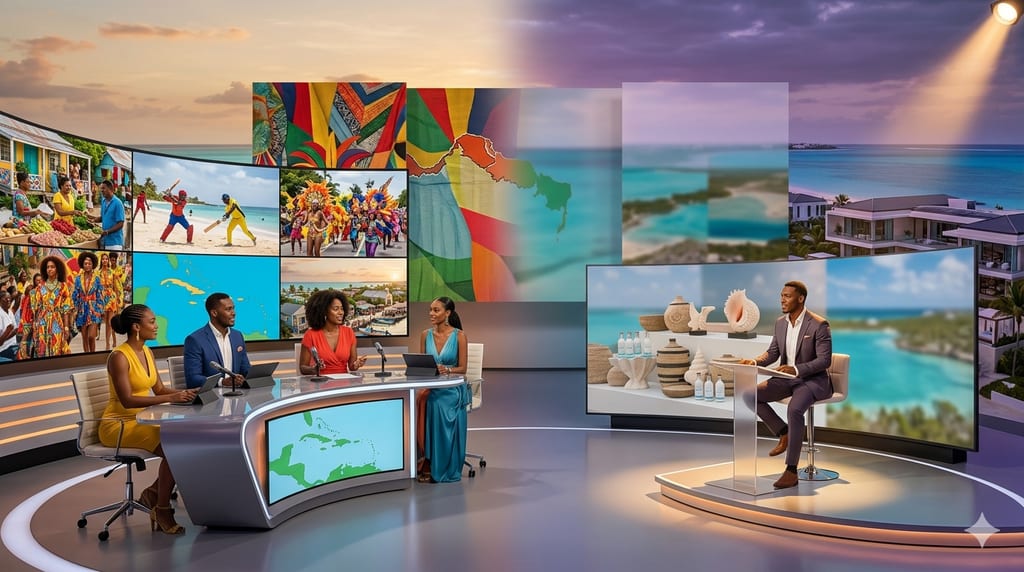
For many people across the Caribbean, Turks and Caicos is instantly recognizable, but often for a narrow set of reasons. Luxury travel, clear waters, high end resorts. The image is polished, attractive, and marketable.
But that image is only one part of the story.
What is less visible is the everyday reality of the islands. The culture, the debates, the challenges, the voices shaping local identity. These rarely make it into the wider Caribbean media space in any consistent or meaningful way.
That raises a question worth examining. Should Turks and Caicos have a stronger presence in regional media, or is its current level of visibility simply a reflection of its size and position?
Visibility Without Representation
Turks and Caicos is not invisible. It appears frequently in international and regional conversations, but usually through a specific lens.
Tourism driven coverage dominates.
This creates a form of visibility that does not translate into representation. The islands are seen, but not fully heard. Stories about policy, youth culture, business development, or social issues rarely reach a broader Caribbean audience.
When they do, they are often filtered through external perspectives rather than local voices.
That distinction matters.
Being talked about is not the same as being part of the conversation.
Size and Scale as a Limiting Factor
One argument against expanding media presence is practical.
Turks and Caicos is a smaller territory compared to regional players like Jamaica, Trinidad and Tobago, or Barbados. These countries have larger populations, more established media industries, and greater output.
From that perspective, media influence tends to follow scale.
Larger countries produce more content, have bigger audiences, and therefore dominate regional narratives. Turks and Caicos, by comparison, has fewer platforms and limited reach.
But this argument has a weakness.
It assumes that influence is only tied to volume, not to uniqueness or perspective.
The Case for a Stronger Voice
There is a growing case for why Turks and Caicos should play a more active role in Caribbean media.
First, its perspective is distinct.
As a British Overseas Territory, its political and economic structure differs from many independent Caribbean nations. This creates a different set of experiences and viewpoints that are not always reflected in regional discussions.
Second, its rapid development presents stories that resonate beyond its borders.
Issues such as rising cost of living, immigration, tourism dependency, and cultural identity are not unique to Turks and Caicos. They are shared across the Caribbean. The difference lies in how these issues play out locally.
A stronger media voice would allow these experiences to contribute to wider regional conversations.
Third, there is an audience for it.
Caribbean media consumers are increasingly interested in cross island perspectives. Social media has already blurred boundaries, allowing content from smaller territories to reach wider audiences. The demand exists, even if the supply has not fully caught up.
Barriers That Cannot Be Ignored
Expanding media presence is not just about intent. There are real constraints.
- Limited funding for independent media platforms
- Smaller talent pools within journalism and content creation
- Reliance on external platforms for distribution
- Competition with larger, more established media networks
These factors make it difficult to scale local media in a way that competes regionally.
There is also the issue of consistency.
A stronger voice requires regular, high quality output. Without that, it becomes difficult to build credibility or maintain audience attention over time.
The Role of Digital Platforms
If traditional media structures are limited, digital platforms offer an alternative path.
Social media, online publications, and independent content creators have already started to shift how stories are told. Turks and Caicos does not need to match the scale of larger countries to be heard. It needs to be strategic.
- Focus on unique, locally grounded stories
- Maintain credibility through accurate reporting
- Build niche audiences rather than chasing mass appeal
- Collaborate with regional platforms to extend reach
This approach prioritizes impact over volume.
It also aligns with how modern media consumption works. Audiences are less tied to national outlets and more open to discovering content across borders.
A Question of Responsibility
There is another angle that complicates the discussion.
Should Turks and Caicos actively seek a bigger media voice, or should it focus on strengthening its internal media landscape first?
Expanding outward without a solid local foundation can lead to inconsistencies in quality and messaging. At the same time, waiting for perfect conditions may mean missing opportunities to shape regional narratives.
A balanced approach would involve strengthening local journalism while gradually increasing regional engagement.
What Is at Stake
This is not just about visibility.
Media presence influences perception. It shapes how a place is understood both within the region and beyond it. If Turks and Caicos remains defined primarily by tourism imagery, other aspects of its identity risk being overlooked.
That has long term implications.
- Policy discussions may lack regional context
- Cultural contributions may remain underrecognized
- Local voices may be excluded from broader conversations
A stronger media voice is not about competing with larger countries. It is about ensuring that the islands are represented in a way that reflects their full reality.
So, Should It?
The answer is not a simple yes or no.
Turks and Caicos does not need to dominate Caribbean media, but it does have a case for being more present within it.
The real question is how that presence is built.
If it focuses on authenticity, consistency, and perspective, it can carve out a meaningful space without relying on scale. If it tries to replicate larger media models without the same resources, it risks losing direction.
In the end, a bigger voice is less about volume and more about clarity.
It is about telling stories that only Turks and Caicos can tell, and making sure they are heard beyond its shores.