
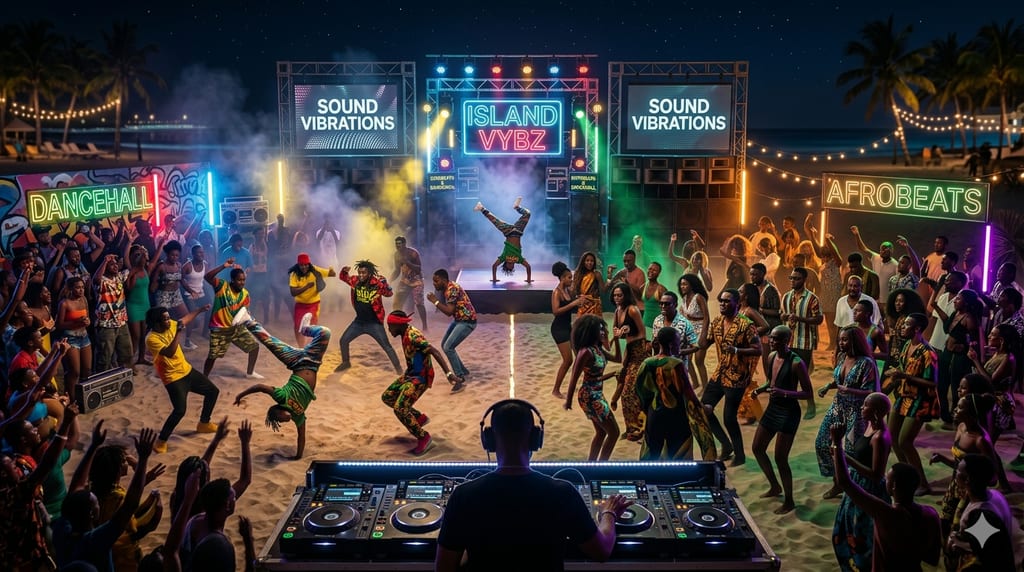
Walk into any party in Turks and Caicos on a Friday night and you will feel it before you hear it clearly. The bass hits first. Then the rhythm finds you. And somewhere in the middle of that sweaty, electric room, a debate that has been simmering across the Caribbean for years is playing out in real time on the dance floor. Two sounds. Two cultures. Two energies fighting for the same speaker. Dancehall and Afrobeats are both commanding the night, and the conversation about which one is really running island parties right now is one that DJs, partygoers, and culture lovers cannot stop having.
It is not a simple rivalry. It is not even really a rivalry at all, if you ask the right people. It is more like a negotiation between two powerful musical traditions, both rooted in the African diaspora, both built on rhythm and resistance and joy, but arriving at the party from very different directions.
Dancehall’s Deep Roots in the Islands
To understand why dancehall holds the kind of emotional grip it does across the Caribbean, you have to appreciate what it represents beyond the music itself. Dancehall is not just a genre. It is a cultural institution that grew out of the streets and yards of Jamaica and spread through the Caribbean like something organic and unstoppable. For generations of islanders, dancehall has been the soundtrack to celebrations, heartbreaks, political frustrations, and everyday life.
In Turks and Caicos, as in most of the English-speaking Caribbean, dancehall has historical roots that go deep. Artists like Vybz Kartel, Popcaan, Spice, and Alkaline are not just musicians here – they are cultural figures whose music carries weight and meaning for people who grew up hearing it. The cadence of dancehall fits the Caribbean tongue naturally. The slang, the references, the riddims – they feel like home because, in many ways, they are.
At island parties, when a DJ drops the right dancehall track, something specific happens in the room. People do not just dance. They respond. They know the lyrics. They feel the history behind the sound. There is a collective recognition that goes beyond entertainment. That kind of connection is not easily replaced or replicated.
The Afrobeats Wave
Then there is Afrobeats. And if you have been to any party in the Caribbean in the last five years, you already know that this sound has not just arrived – it has taken over significant territory and it is not giving it back.
What started as a West African movement, shaped by Nigerian artists like Wizkid, Burna Boy, Davido, and Tems, has become one of the most dominant sounds in global popular music. Afrobeats carries a rhythm that seems almost designed to dissolve inhibition. The tempo is infectious. The melodies sit somewhere between familiar and completely fresh. And there is a joy in the sound – a buoyancy – that translates across languages, cultures, and backgrounds with remarkable ease.
In Turks and Caicos, the Afrobeats wave arrived with particular energy because of the island’s increasingly diverse population. Workers, residents, and visitors from across the Caribbean, Africa, and beyond have brought the sound into the social fabric of the islands in a way that feels natural rather than imposed. When Wizkid’s “Essence” or Burna Boy’s “Last Last” fills a room, it does not matter where you are from. Your body figures out what to do without you having to think about it.
That universality is one of Afrobeats’ greatest strengths at parties. It is a sound that brings people together across cultural lines in a way that even the most beloved dancehall tracks sometimes cannot, simply because not everyone in the room shares the same Caribbean context.
What the DJs Are Actually Playing
Here is the truth that the most honest DJs in Turks and Caicos will tell you: the real answer to which genre is running island parties right now is not one or the other. It is the blend.
The DJs who are filling dance floors and keeping energy levels high are the ones who understand that these two sounds are not competitors so much as complements. A skilled DJ will move from a Popcaan record into a Rema track and watch the room stay just as hyped, because the underlying rhythm of both genres shares African DNA. They breathe differently, but they come from the same lungs.
What has shifted noticeably in recent years is the sequencing. A few years ago, an island party set might be predominantly dancehall with a few Afrobeats tracks sprinkled in as novelty. Today, the ratio has changed. Afrobeats gets genuine, sustained rotation. Amapiano – a South African genre with piano-driven grooves and log drum basslines – has even started making appearances, adding another layer to the sonic conversation.
The crowd, too, has evolved. Younger partygoers in Turks and Caicos have grown up with both sounds as equally valid parts of their musical identity. For them, there is no loyalty conflict. They move from dancehall to Afrobeats and back again the way water moves – without resistance and without needing to explain themselves.
The Cultural Stakes Behind the Music
Underneath the fun, there is a real cultural question embedded in this musical conversation. As Afrobeats continues to grow its global footprint – appearing in Hollywood films, on international awards stages, and in the playlists of mainstream pop stars – some Caribbean voices have begun to ask whether the regional dominance of dancehall is being quietly eroded.
It is a fair question. Cultural influence in music is tied to economic power, media reach, and the platforms that amplify certain sounds over others. Nigerian artists and their labels have invested heavily in global distribution, marketing, and collaboration. The reach of Afrobeats today dwarfs what any Caribbean genre – dancehall included – commands on the international stage at this particular moment.
But in the islands, on the ground, in the actual rooms where parties happen and communities gather, dancehall has not been dethroned. It has been joined. And there is a meaningful difference between those two things.
The Verdict from the Dance Floor
If you really want to know what is running island parties in Turks and Caicos right now, stop asking the critics and start watching the dance floor. Watch what makes someone leave their seat. Watch what causes a stranger to grab their friend’s arm and pull them closer. Watch what the room does when the first few notes of a track drop before the beat even kicks in.
What you will see is this: both sounds have the power to move people. Both carry cultural weight. Both belong here. Dancehall brings history and identity. Afrobeats brings energy and universality. The island party, at its best, holds space for both.
The real winner is not a genre. It is the music itself – and the people who know how to feel it.