
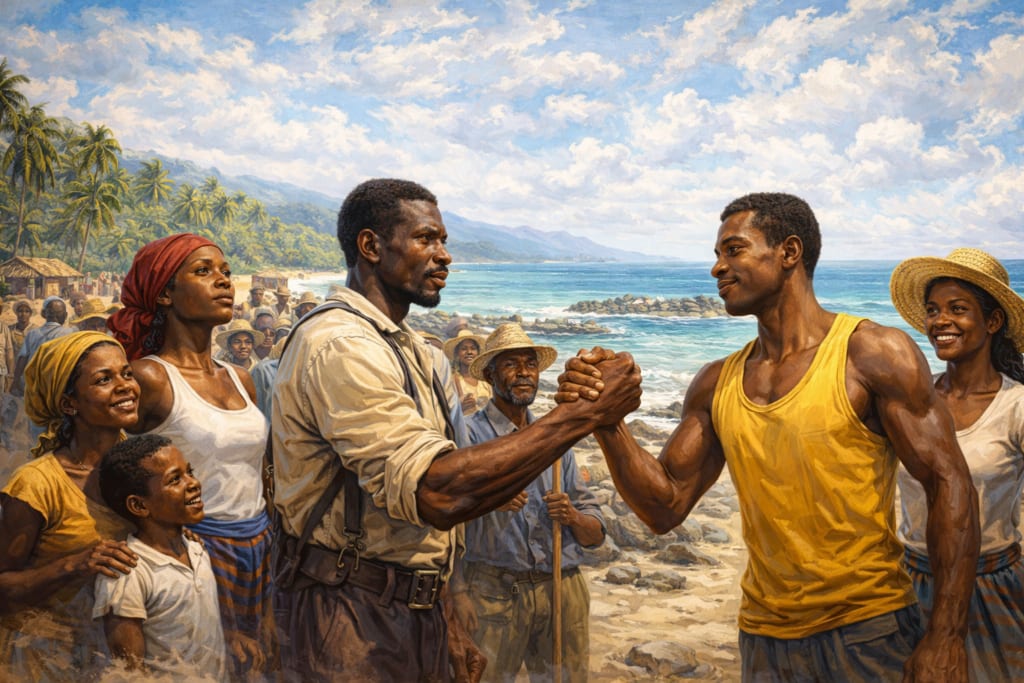
In Turks and Caicos, the Haitian presence is visible in everyday life, from construction sites and local markets to churches, music, and community gatherings. It is a presence shaped by history, necessity, and resilience. At the same time, it remains one of the most debated topics across the islands.
For some, Haitians represent hard work, cultural richness, and essential contributions to the economy. For others, the conversation quickly shifts to concerns about immigration, resources, and national identity. These competing views often exist side by side, rarely meeting in a balanced discussion.
To understand the issue properly, it is necessary to move beyond assumptions and look at the full picture, including culture, economic impact, and the tensions that continue to surface.
A Community Rooted in Movement
The connection between Haiti and Turks and Caicos did not emerge overnight. Migration has been driven by a combination of economic opportunity and instability in Haiti. Over the years, many Haitians have arrived seeking work, safety, and a chance to build a better life.
This movement has created one of the largest immigrant communities in the territory.
In many ways, Haitians have become part of the social and economic fabric of Turks and Caicos. Their presence is not temporary or peripheral. It is deeply embedded in how the islands function on a daily basis.
Cultural Influence That Shapes Identity
Haitian culture has added a distinct layer to life in Turks and Caicos.
You can hear it in music, where rhythms and sounds blend across Caribbean influences. You can taste it in food, where Haitian dishes bring bold flavors and techniques that have become familiar to many residents. You can see it in religious practices, language, and community traditions that continue to thrive.
This cultural exchange is not one sided. It reflects the broader Caribbean reality, where movement between islands has always shaped identity. Turks and Caicos itself is a product of these overlapping influences.
Yet cultural contribution is not always acknowledged in public discourse. It is often overshadowed by political and social concerns, which tend to dominate headlines and conversations.
Economic Contribution That Often Goes Unnoticed
One of the most consistent realities is the role Haitians play in the local economy.
Across sectors such as construction, hospitality, and domestic work, Haitian labor is widely present. Many businesses rely on this workforce to operate efficiently. Projects that define the islands’ development, including hotels, homes, and infrastructure, often depend on their involvement.
This raises an important point.
While immigration is frequently debated, the economic reliance on immigrant labor is rarely questioned with the same intensity. There is a clear tension between dependence and criticism.
Some argue that Haitians take up jobs that could go to locals. Others counter that many of these roles are difficult to fill, either due to skill gaps or lack of interest. The reality likely sits somewhere in between, but the conversation is often framed in extremes.
The Controversy That Refuses to Fade
The most sensitive part of the discussion revolves around immigration and legality.
Concerns about undocumented migrants, border control, and access to public services continue to fuel debate. These issues are not unique to Turks and Caicos, but in a smaller territory, their impact feels more immediate.
- Pressure on healthcare and education systems is often cited
- Questions around housing and informal settlements are raised
- National identity and cultural preservation become part of the conversation
These concerns are real, but they are also frequently generalized. The actions or status of some individuals are often used to define an entire community.
That is where the conversation becomes problematic.
When discussions shift from policy to perception, they can easily lead to stereotyping and division. Instead of addressing structural issues, the focus moves toward blame.
Between Perception and Reality
One of the biggest challenges is the gap between how Haitians are perceived and how they actually live and work within the community.
On one hand, there are narratives that portray them as a burden. On the other, there are countless examples of individuals contributing positively, raising families, starting small businesses, and participating in community life.
Both realities exist, but they are not equally represented in public conversations.
Social media has amplified this imbalance. Stories that highlight conflict or controversy tend to spread faster than those showing everyday contributions. As a result, the overall perception becomes skewed.
A Policy Issue, Not Just a Social One
It is important to recognize that many of the challenges linked to the Haitian presence are not purely social. They are policy driven.
Immigration systems, labor regulations, and enforcement mechanisms all play a role in shaping the current situation. Without clear and consistent policies, gaps are created. Those gaps often lead to informal systems that are harder to manage and regulate.
Blaming individuals for navigating those systems does not address the root of the issue.
A more effective approach would involve:
- Clear and enforceable immigration policies
- Fair labor practices that protect both locals and migrant workers
- Better integration strategies for long term residents
- Open public dialogue that separates fact from assumption
These steps require coordinated effort, not just public opinion.
The Human Side of the Story
At the center of this conversation are people.
Individuals who left difficult circumstances, often at great risk, to find opportunity. Families trying to build stability. Workers contributing to industries that keep the economy moving.
Reducing this to a single narrative, whether positive or negative, does not reflect reality.
It is also worth considering how identity evolves in a place like Turks and Caicos. With multiple cultures intersecting, the definition of community is constantly shifting. That process can create tension, but it can also lead to growth.
Moving Toward a More Balanced Conversation
The Haitian presence in Turks and Caicos is not a simple issue. It involves culture, economics, policy, and perception, all interacting at once.
Simplistic arguments, whether supportive or critical, tend to miss that complexity.
A more balanced conversation would acknowledge both contribution and concern. It would recognize the value Haitians bring while also addressing the structural challenges that exist.
Most importantly, it would move away from generalizations.
Because in the end, the question is not whether the Haitian presence is good or bad.
The real question is how Turks and Caicos chooses to manage, understand, and integrate that presence in a way that reflects both its values and its future.